

What We Keep Feeding
On sourdough, neighbors, and Minnesota's quiet resistance

A few weeks ago, I posted this little story on Substack Notes about bringing my neighbor a loaf of sourdough bread. Then this week my friend Sean Snow elaborated on the magick of sourdough.
Today’s post was inspired by both.
TeriLeigh💜
On a 15 degree day in mid February, my neighbor Steve snow-blowed the sidewalks again.
He does the entire block, both sides, every time it snows more than two inches.
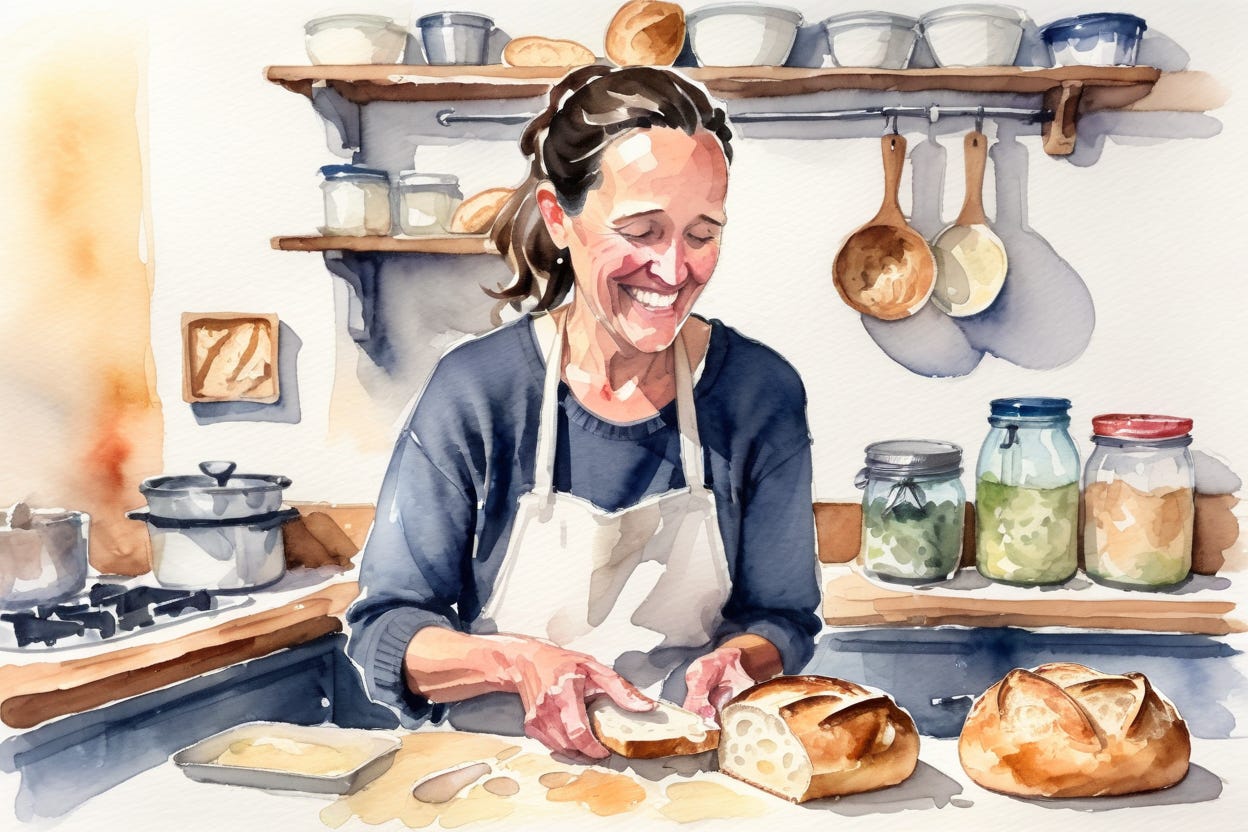
I bring him a loaf of homemade sourdough.
Steve displayed Trump signs during the election. Amy, the neighbor between us, has a pride flag and one of those little wiggle-walk signs on her front lawn. I bring Amy sourdough when she feeds my dog if I can’t get home in time.
Amy has long chats with Steve about his grandkids while she’s weeding her garden.
I keep encouraging Steve to wiggle when he snow-blows her sidewalk. I’m convinced someday he will.
Steve told me about his cancer with this matter-of-fact calm, and I offer him a hug —one hand holding his loaf of sourdough, and the other hand wrapped around his shoulder.
I don’t care who he voted for. He’s a good guy facing something terrible, and he does it with grace. . . He is sourdough-worthy.

Sean Snow
One of the stranger things about COVID was how many of us became sourdough people overnight. People were trading tips, sharing jars, and finding comfort in keeping this one small living thing alive during an uncertain time.
On its own, sourdough starter does not look like much, just a cloudy little jar on a counter… but if you feed it, protect it, and pass it along, it grows into something that can nourish a lot of people.
That feels like Minnesota right now.
It rarely starts with something dramatic. It starts small, gets tended, and grows because people keep showing up for it. The jar may be small, but what grows inside it can feed a lot of people.
The starter needs the right environment to grow.
TeriLeigh💜
The oldest sourdough artifacts are about 4,500 years old, recovered from ancient Egyptian clay pots. Medieval monasteries maintained their starters for centuries, treating them as living members of the community. Families carried their starters across oceans in the holds of ships, because to lose the starter was to lose their history. During the California Gold Rush, San Francisco sourdough bakers were so protective of their starters that they slept with them on cold nights, holding the jar close to their bodies to keep the culture warm.
The culture in a Minnesota sourdough starter reflects the bacteria and yeast specific to this region — our cold winters, our humid mosquito-ed air, the flour milled from grain grown in our soil.
Baking sourdough is a community project. You receive a starter from a neighbor, and feed it with flour and water. Then, you share the discard with someone else, who feeds it and shares the discard with someone else. One jar, tended faithfully, can eventually feed an entire city.
The starter doesn’t care about politics.
It feeds everyone.
Sean Snow
A sourdough starter takes patience at first.
In the beginning, you have to keep tending it before you get anything back, trusting that something good is growing even when it just looks like a quiet jar on the counter. But once it is alive, keeping it going is much simpler.
That is what this moment feels like to me.
A city council vote, one court deadline, one bill, one hat, one neighbor showing up… each small on its own, but together becoming something strong enough to feed people through a hard season.
Federal overreach depends on fear spreading faster than care. Our job is to keep feeding that care until it grows stronger than the fear.
TeriLeigh💜
This is where we are right now. The days when it would be easy to look at the jar and conclude that nothing is working. But the wild yeast is already here, in the hands of every Minnesotan who keeps showing up.
And there are a lot of them.
There is ChongLy “Saly” Scott Thao, who lives just half a block from my favorite East-Side neighborhood pub, a naturalized U.S. citizen, a Hmong elder. His mother had been a nurse who treated American soldiers during the Secret War in Laos. He became a citizen the right way. While his toddler grandson was napping on the couch, federal agents broke through the door with guns drawn. Saly was led outside bare-chested in Crocs and boxer shorts and a children’s blanket in single-digit temperatures. His neighbors showed up, blowing whistles in the street and yelling. ICE drove him around for an hour, confirmed he had no criminal record, and dropped him back at his apartment like nothing happened.
A sourdough starter needs witnesses. It needs someone paying attention. That’s what those neighbors were. That’s all they were, watching, documenting, bearing witness.
There is Stella Carlson, who was on her way to a church to paint children’s faces when she saw federal agents in her neighborhood. She could have kept driving, but she pulled over instead. She saw a man directing traffic and recording — that man was Alex Pretti. “I was his backup, is how I felt about it,” she said later, through tears.
That is a loaf of bread left on a doorstep, or a back-up jar of starter, passed along, in case the first one didn’t take.
There is Jennifer Briggs, who wrote about what she called Minnesota’s underground human hive — thousands of women organizing through encrypted chats, deploying observers within minutes, making legal calls, running secret grocery runs, doing school drop-offs for families too afraid to leave. “Will history write about these heroines?” she asked.
A living culture doesn’t forget what kept it alive.
There is R.T. Rybak, former mayor of Minneapolis, now leading the Minneapolis Foundation. He launched a $4 million Economic Response Fund. Grants of $2,500 to $10,000 going to the restaurants and shops and service providers who couldn’t open their doors, who were feeding their staff out of their own pockets. He said publicly: “We recognize the needs are much greater.”
He fed the starter with money, quietly, from within the system.
This is also neighboring. This is also bread. (why do you think we call money “dough”?)
There is Annie Ganger, sister of Renee Good, who flew in from out of state to speak at her sister’s memorial in Powderhorn Park. She looked out at the crowd of thousands who had been caring for Renee’s memory for a month, in the cold, without being asked, and she said: “We who do not live in this area see this powerful work that you’re doing, and it encouraged us to dive into our own communities.”
Then she told us what she thought her sister’s advice would be, right now, in all of this:
“Take care of yourselves. Care for your neighbors. Receive care from your neighbors. Rest and eat, and play, and show up.”
That is a sourdough recipe if I have ever heard one.
When someone asks me what Minnesota tastes like right now, I think: a little sour, and very much alive.
Sourdough tastes different from every other bread. The sourness is lactic acid, produced by bacteria as they ferment. But lactic acid is also what lives in your muscles after a hard run, in your gut when your microbiome is healthy, in fermented foods that have sustained human life for ten thousand years. The sourness is evidence of life, proof that something is working.
What we keep feeding will be what survives.
The starter or the fear.
The culture or the rot.
The bread or the silence.
Steve is still out there in the cold. Amy will wave from her garden the first warm day we get. . . I’m going to go bake more bread.
This is such a lovely article. I woke up this morning feeling depressed and wondering what hellacious news would be dropped on our psyche today. And then I read your article. My heart sang. Thank you for the virtual sourdough bread, Teri! ❤️🥪
Great job. This was great.